
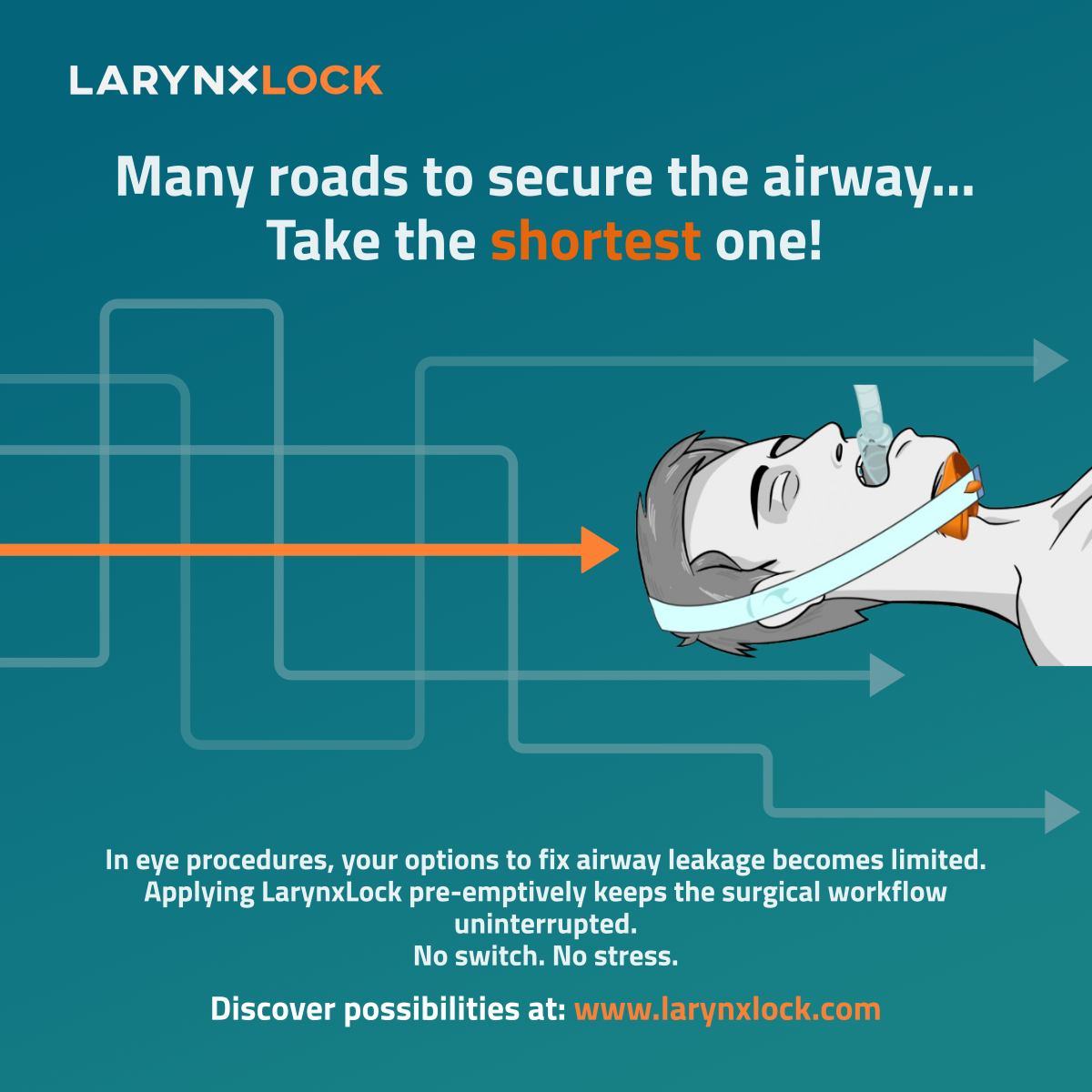
In ophthalmic surgery, laryngeal masks (LMAs) are widely used over endotracheal tubes: they offer stable hemodynamics, avoid intraocular pressure spikes, and prevent coughing on emergence, which protects delicate sutures.
Eye procedures frequently require rotating the patient’s head toward the operating surgeon. However, literature shows that head and neck positioning lowers oropharyngeal leak pressure and compromises glottic alignment across multiple supraglottic device types (Kim et al., 2019; Mishra et al., 2015).
When a leak occurs mid-procedure, your usual fixes are out of reach: Repositioning the head disrupts the micro-surgical field, re-adjusting the cuff under sterile drapes is difficult and unreliable, and converting to endotracheal intubation means stopping surgery, breaking the sterile field, and rebuilding an airway under extreme time pressure.
Thus, applying LarynxLock pre-emptively is recommended.
Applying LarynxLock prior to draping stabilizes the pharyngeal anatomy from the start by supporting the floor of the mouth. It maintains sealing integrity during head rotation—preventing air leaks before they happen, eliminating high-risk mid-case interventions, and keeping the surgical workflow uninterrupted.
References:
- Kim et al. (2019): Systematic review on head/neck position & SAD performance. https://doi.org/10.1371/journal.pone.0216673
- Mishra et al. (2015): Head position impact on oropharyngeal leak pressure. https://doi.org/10.1155/2015/705869